Clean Up Noisy Speech

Real-world speech is rarely clean. Microphones pick up background noise, room reverb, and competing speakers. Speech enhancement algorithms try to recover the original speech from a noisy recording. In this example we add controlled noise to a clean signal, apply an MMSE estimator to clean it up, and measure how much we recovered.
The audio clip is CMU Arctic arctic_a0005.wav from speaker bdl - a recording of the sentence:
"For the twentieth time that evening the two men shook hands."
Adding noise
Before we can test an enhancement algorithm, we need noisy speech with a known signal-to-noise ratio (SNR). The SNR measures how much louder the speech is compared to the noise, in decibels:
At 0 dB, the noise has the same power as the speech - it's very difficult to understand. At 10 dB, the speech is 10x more powerful than the noise - noticeable but manageable.
v_addnoise adds white Gaussian noise to a signal at a target SNR. The 'k' flag preserves the original signal level (without it, the function normalises total power to 1, which can distort the scale):
from pyvoicebox import v_addnoise

noisy_0db, _ = v_addnoise(clean, fs, 0, 'k')    # equal noise and speech power
noisy_5db, _ = v_addnoise(clean, fs, 5, 'k')    # speech is ~3x louder
noisy_10db, _ = v_addnoise(clean, fs, 10, 'k')  # speech is ~10x louder
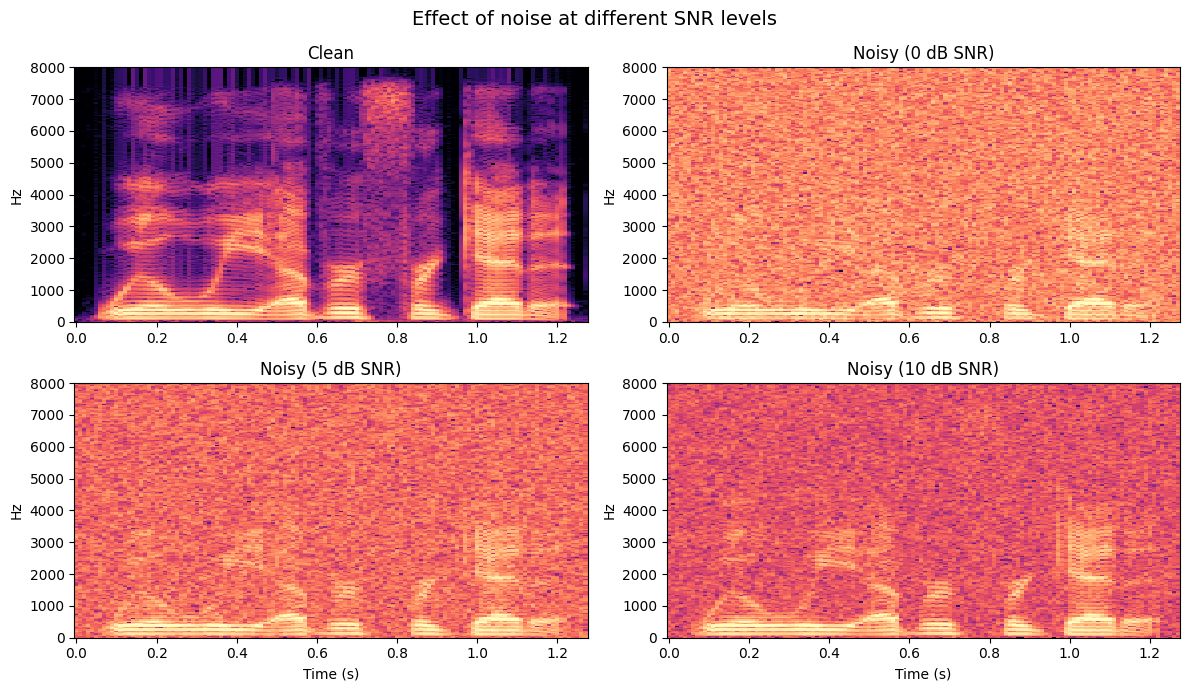
In the spectrograms above, notice how the formant bands (the horizontal bright lines that carry vowel information) become progressively harder to see as the SNR drops. At 0 dB, the noise floor almost completely masks the speech structure.
MMSE speech enhancement
The Minimum Mean Square Error (MMSE) spectral amplitude estimator is a classical approach to single-channel noise reduction. The idea is:
- Estimate the noise spectrum from non-speech regions (or track it adaptively).
- For each time-frequency bin, estimate the a priori SNR - how much speech energy is expected relative to the noise.
- Compute a gain function that attenuates bins dominated by noise and preserves bins dominated by speech.
- Multiply the noisy spectrum by this gain to get the enhanced spectrum.
The gain for each bin depends on the estimated SNR through a modified Bessel function, which gives the MMSE-optimal spectral amplitude estimate under Gaussian assumptions.
v_ssubmmse handles all of this in one call:
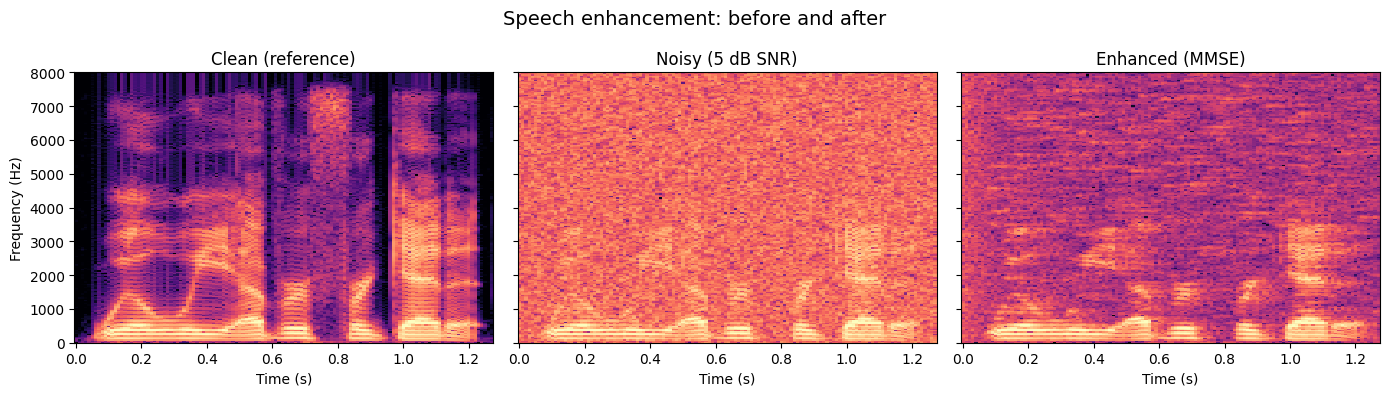
Comparing the three spectrograms:
- Clean (left) - sharp formant bands, clear harmonic structure.
- Noisy (centre) - the 5 dB noise floor fills the gaps between harmonics and blurs the formants.
- Enhanced (right) - the noise floor is substantially reduced. The formant bands reappear, though some very quiet speech segments may lose energy (a common trade-off called "musical noise").
Measuring improvement
Subjective listening is important, but we also want a number. v_snrseg computes two metrics by comparing the enhanced signal against the clean reference:
- Global SNR - the overall power ratio across the entire signal.
- Segmental SNR - the average SNR computed per short frame. This is more perceptually meaningful because a single loud noise burst won't dominate the average.
from pyvoicebox import v_snrseg

# Trim signals to the same length
min_len = min(len(clean), len(noisy_5db), len(enhanced))
c, n, e = clean[:min_len], noisy_5db[:min_len], enhanced[:min_len]

seg_before, glob_before, _, _, _ = v_snrseg(n, c, fs)
seg_after, glob_after, _, _, _ = v_snrseg(e, c, fs)
A positive improvement in both metrics confirms the enhancement is working. Typical MMSE enhancement on white noise at 5 dB SNR yields a few dB of improvement - modest, but clearly audible. The notebook includes audio players so you can listen to the clean, noisy, and enhanced signals side by side.